
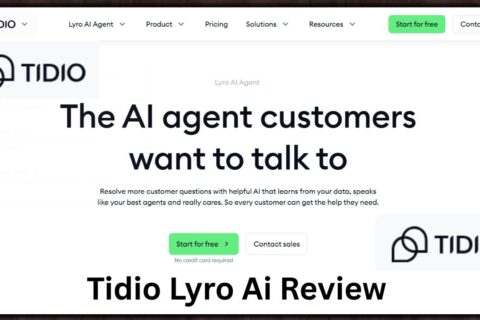
In the following Tidio Lyro review 2026, you will learn if this AI customer support tool is the right fit for your business or not. The discussion below is based on thorough research, official pricing and features, and real user experiences from verified reviews.
Quick Verdict
Tidio is the most accessible AI live chat platform for small businesses in 2026. The free tier is genuinely useful, not just a teaser. Lyro AI handles common questions automatically, and setup takes minutes.
But the pricing has a serious catch. The plan jumps from Growth at $59 per month straight to Plus at $749 per month with nothing in between. That is a 12-fold increase.
Tidio Lyro has a success score of 3.8 on Trustpilot. And if your business stays within Growth plan limits, Tidio is solid value. The moment you outgrow it, the pricing wall hits hard.
What Is Tidio?
Tidio is a digital customer service platform. It combines live chat, help desk, chatbots, and AI agents in one interface. It lets businesses provide real-time support, automate common questions, and manage tickets across chat, email, and social channels. Lyro is Tidio’s AI agent.
It is powered by Anthropic’s Claude. Unlike rule-based bots that follow rigid scripts, Lyro understands customer questions and generates natural responses. You need to train it on your own support content. It handles the repetitive questions pretty easily. And your team handles everything else.
What Tidio Is Actually Good At
Getting Your Business Live in Under an Hour.
The chat widget installs in minutes via a code snippet or a one-click WordPress plugin. Most users report going from sign-up to first live conversation in under 20 minutes. No developer or coding expertise needed. And there is no complicated setup.
Handling Most of Your Support Questions Without a Human.
Lyro understands what customers are asking and responds in natural language. It keeps track of the context throughout the conversation so it feels smooth and continuous rather than broken up.
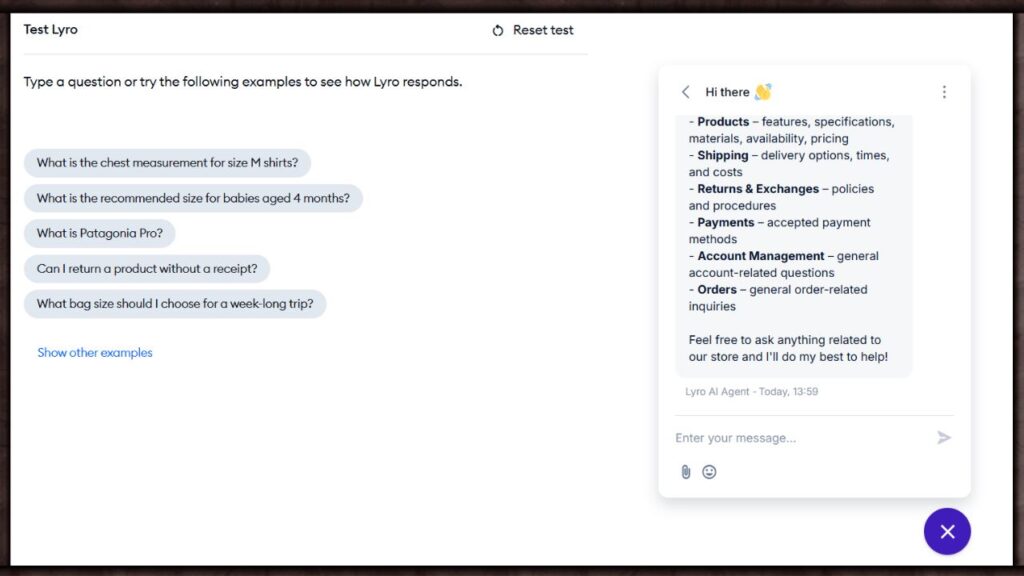
The 67% automation rate is backed by case studies and user reviews. Some businesses reach 60 to 85% automation of routine questions.
One real example: Axioma, a UK-based car repair service, reached an 89% AI resolution rate after setting up Lyro. The AI handled questions about pricing, services, and insurance claims without any human input.
Managing all Your Channels from One Place.
The help desk includes a shared inbox, ticket routing, and customer satisfaction surveys. Website chat, Facebook Messenger, Instagram, WhatsApp, and email all come into one inbox. Your team does not need to jump between apps.
Working with Shopify and WordPress out of the Box.
There is a native Shopify app with one-click install. It syncs customer data, order info, and lets Lyro answer order status questions automatically.
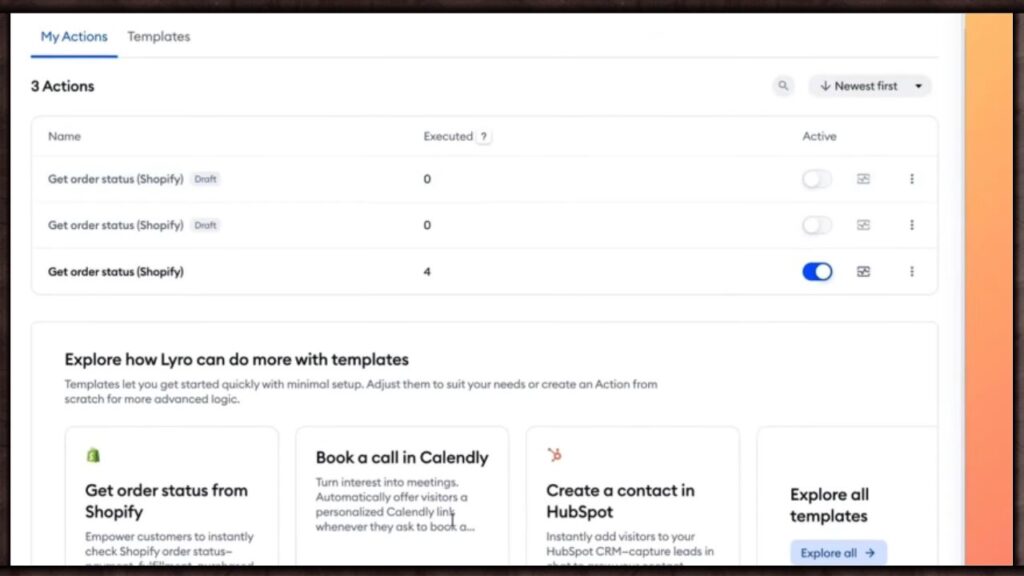
A customer asking where their order is gets an instant answer. Nobody on your team needs to type a word.
Recommending Products While it Handles Support.
By reading what users say during a chat and using your store data, Lyro can suggest relevant products in real time. One e-commerce brand found that over 50% of visitors who clicked the chat widget ended up making a purchase after Lyro guided them.
Where Tidio Falls Short
The pricing structure is the most consistent complaint across every review platform. Between Growth at $59 and Plus at $749, there is a 12-fold jump with no plan in between. For any small business that needs more than 10 agent seats, this is a serious problem.
The add-on structure means the advertised price is almost never what you actually pay. On Free and Starter plans, you get 50 Lyro AI conversations total, not per month.
Once those run out, Lyro stops responding. To keep AI running on the Starter plan, you need the Lyro add-on at $39 per month. A Starter plan with 200 Lyro conversations ends up costing $107 per month, not $29.
There was also a trust issue in late 2024. Tidio doubled bills for existing customers in December 2024 without enough warning. And Users reported automatic charges without prior notice. This was called “bait and switch” by many users and continues to affect how people view Tidio in 2026.
And guys, when I look at Tidio from this angle, it doesn’t look good.
Also, one more thing worth knowing: some users report issues with the AI chatbot logic around translation. Others find it frustrating that premium features are constantly shown but locked behind much higher-priced plans.
Tidio Pricing 2026
Four main plans: Starter at $29 per month, Growth at $59 to $349 per month depending on conversation volume, Plus at $749 per month, and Premium from $2,999 per month. All self-serve plans are capped at 10 agents.
| Plan | Price | Conversations/Month | Lyro AI Included | Agent Seats | Best For |
| Free | $0 | 50 | 50 one-time only | 3 | Testing the platform |
| Starter | $29/month | 100 | 50 one-time only | 3 | Very small teams, low volume |
| Growth | $59/month | 250 to 2,000 | Add-on from $39/month | 10 max | Most small businesses |
| Plus | $749/month | Custom | Included (5,000) | Unlimited | Scaling businesses |
| Premium | From $2,999/month | Custom | Included (10,000) | Unlimited | Enterprise |
All paid plans include a 7-day free trial with no card required. Annual billing saves around 17%.
What Most Small Businesses Actually End Up Paying:
A fully set up Growth plan with Lyro AI and Flows automation runs about $110 per month. That is triple the advertised Starter price. Know this before you sign up.
Tidio AI vs Competitors
| Tool | Starting Price | Free Plan | AI Included | Best For | Weakest At |
| Tidio | $29/month | Yes (50 conversations) | Add-on from $39/month | Small e-commerce, Shopify stores, fast setup | Pricing cliff at Growth to Plus, AI not included in base plans |
| Freshdesk | $15/agent/month | Yes (up to 2 agents) | Freddy AI on Pro ($49) and above | Growing teams needing full helpdesk and ticket management | Less suited for live chat-first e-commerce workflows |
| Zendesk | $19/agent/month | No (free trial only) | AI add-on, priced separately | Scaling businesses needing advanced routing and deep analytics | Expensive, steep learning curve, high implementation costs |
| Intercom | From $39/month | No | Fin AI included on all paid plans | SaaS businesses, product-led growth teams | Too expensive for small product or e-commerce businesses |
Read Full Zendesk Review HERE!
Read Full Freshdesk Review HERE!
A Few Honest Notes on This Comparison:
Freshdesk wins on ticket management depth. If your business receives a steady flow of complex support requests through email and phone, Freshdesk handles those better than Tidio. The free plan for up to 2 agents is also one of the most generous in this category.
Zendesk is the most powerful option on the list. It handles enterprise-level routing, SLA management, and reporting. But Tidio charges nothing for setup or onboarding across all plans. Zendesk and Intercom often charge $5,000 to $15,000 in implementation fees. For a small business that needs something working this week, Zendesk is overkill.
Intercom’s Fin AI is included in paid plans without a separate add-on, which makes it more straightforward to price than Tidio. But Intercom is built primarily for SaaS and software products, not e-commerce. If you sell physical products on Shopify, Tidio’s native integration beats Intercom handily.
Who Tidio Is Actually For
In 2026, Tidio remains the best all-around choice for the small business owner who needs to balance budget, ease of use, and features. It is not the cheapest option if you have massive traffic. It is not the most advanced if you have a 50-person support team.
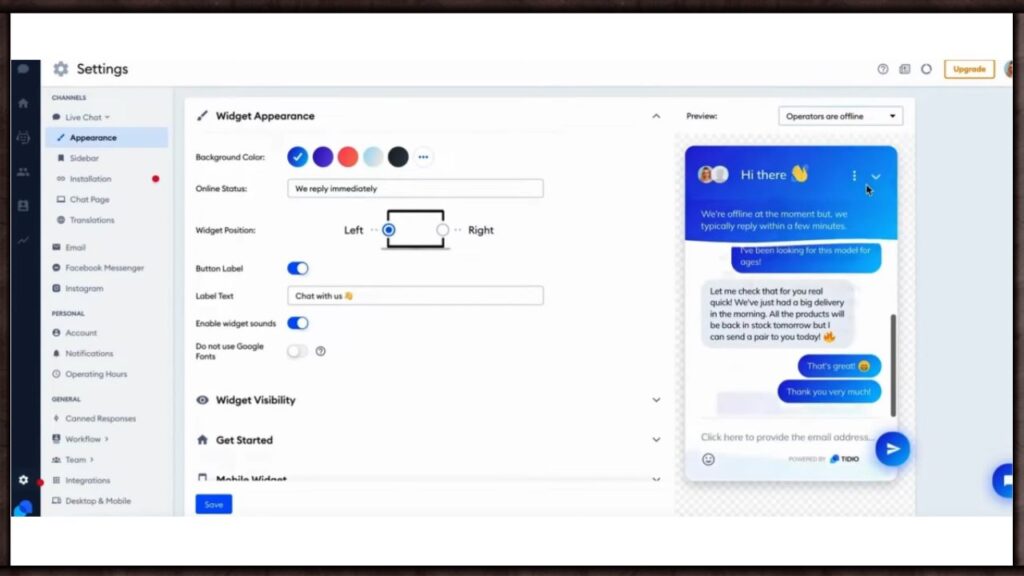
But it is the most accessible. E-commerce stores on Shopify or WooCommerce handling under 2,000 support conversations a month are the sweet spot. If you are responding to customer questions between other tasks and need something running today, this is your tool.
Who Should Skip It
If your support team has more than 10 people, the Growth plan caps you. The jump to Plus at $749 is not realistic for most small businesses. Large businesses should compare Tidio Plus against Intercom or Zendesk before committing. Also, if your business requires highly personalised answers rather than repeatable responses, Lyro will hit its ceiling fast. One G2 user from a tea shop said it well: their products required “more personal, thought-out answers” so they stopped using Lyro but still recommended Tidio for live chat.
What I Like About Tidio
The setup speed is the best in this category. Most tools take days to configure properly. Tidio is live on your site in under an hour. The free plan is also real, not a fake trial. And the Shopify integration is the smoothest of any live chat tool at this price range. Order status questions get resolved automatically. No team involvement needed.
What I Don’t Like About Tidio
The pricing gap between Growth and Plus is a genuine problem. There is no middle ground for a business that needs 12 agents or 3,000 conversations per month. The December 2024 pricing incident also left a real trust issue that has not fully gone away.
And the fact that Lyro AI is a completely separate add-on means the advertised price is almost always lower than what you actually pay.
The One Thing That Surprised Us
Lyro is powered by Anthropic’s Claude under the hood. That is not a marketing phrase. It is a technical fact. It explains why Lyro’s ability to understand natural language performs noticeably better than most competitor chatbots at the same price point.
In short, you are getting one of the most capable AI models available, trained on your own support content, as a $39 per month add-on.
Final Take
Tidio is the right starting point for most small businesses that need AI customer support in 2026. Setup is fast, the free plan is real, and Lyro handles a solid chunk of your support volume once it is properly trained.
Just go in knowing the $29 Starter price is not what you will actually pay once Lyro and Flows are added. Budget for $100 to $150 per month for a properly set up Growth plan, and you will not be caught off guard.
Tidio is one of three tools we recommend for AI customer support. See the full breakdown in our [Best AI Tools for Small Business to Boost Productivity in 2026] guide.
Frequently Asked Questions
Is Tidio free to use?
Yes, there is a permanent free plan with 50 conversations per month and basic live chat. Lyro AI comes as a one-time 50-conversation allocation on the free plan. After that, you need the paid add-on to keep AI running.
How much does Tidio actually cost per month?
Base plans run from $29 for Starter to $59 for Growth. Once you add Lyro AI at $39 per month and Flows at $29 per month, most small businesses pay $100 to $150 per month for a properly working setup.
What is Lyro AI and how does it work?
Lyro is Tidio’s AI agent powered by Anthropic’s Claude. You train it on your FAQ pages and help articles. It then handles incoming customer questions in natural language without scripts, resolving around 67% of queries without a human.
Is Tidio good for Shopify stores?
Yes. The native Shopify integration syncs customer data and order information. Lyro can answer order status questions automatically without any team input needed.
What happens when I hit my Tidio conversation limit?
At 95% of your monthly limit, Tidio automatically upgrades you to the next pricing tier. You can turn off auto-upgrade in settings, but that means conversations get blocked once you hit 100%.
Can Tidio replace a customer support team?
For routine, repeatable questions, yes, Lyro handles up to 67 to 85% of volume automatically. It cannot replace humans for complex or sensitive conversations. The best setup is AI handling the routine work and a small team handling the rest.
Does Tidio work in multiple languages?
Yes. Lyro recognises and responds in over 10 languages including English, Spanish, German, and French without needing separate chatbots for each.
What is the difference between Tidio Starter and Growth?
Starter gives you 100 conversations per month and 3 agent seats for $29. Growth gives you 250 to 2,000 conversations and up to 10 agent seats for $59, plus advanced analytics, automated routing, and satisfaction surveys.
Is Tidio better than Zendesk for small businesses?
For getting started quickly without a big budget or complex setup, yes. Zendesk is more powerful but costs more and takes longer to set up properly. Tidio is the right starting point. Zendesk is where you move to once your support team grows beyond 10 agents.
What are the best Tidio alternatives?
Freshdesk has a free plan for up to 2 agents with solid helpdesk features. Zendesk is the most complete enterprise option. Intercom is the strongest AI-first competitor for SaaS businesses. Crisp at $25 per month is a leaner option for very small teams.



3 Responses