
In the following SEMrush review 2026, you will learn if this AI for SEO is the right fit for your business or not. The discussion below is based on thorough research, official pricing and features, and real user experiences from verified reviews.
Quick Verdict
SEMrush is the most complete digital marketing platform available in 2026, used by over 10 million users including brands like Tesla, Apple, and Amazon. It holds a 4.5/5 on G2 from over 3,300 reviews and a 4.6/5 on Capterra from 2,300 plus reviews.
But here is the honest part — it also holds a 1.9/5 on Trustpilot, and that gap tells you everything. The product is genuinely powerful. The billing experience for smaller users is genuinely problematic. I checked and most SEMrush reviews on Trustpilot are around poor billing support.
If you are a small business owner who needs a full SEO suite and will actively use keyword research, site audits, competitor analysis, and content tools together, SEMrush earns its price. If you only need occasional keyword data, you are paying for far more than you will ever use.
What Is SEMrush?
SEMrush is an all-in-one digital marketing platform built around SEO, content marketing, PPC research, competitor intelligence, and now AI visibility tracking. It was acquired by Adobe on April 28, 2026 for $1.9 billion, making it officially an Adobe subsidiary.
The platform covers 55 plus tools, 26.5 billion keywords globally, and over 43 trillion backlinks from 390 million referring domains. In 2025, SEMrush launched Semrush One which is a new bundle that combines its classic SEO toolkit with AI visibility tracking across ChatGPT, Google AI Overviews, Gemini, and Perplexity.
What SEMrush Is Actually Good At
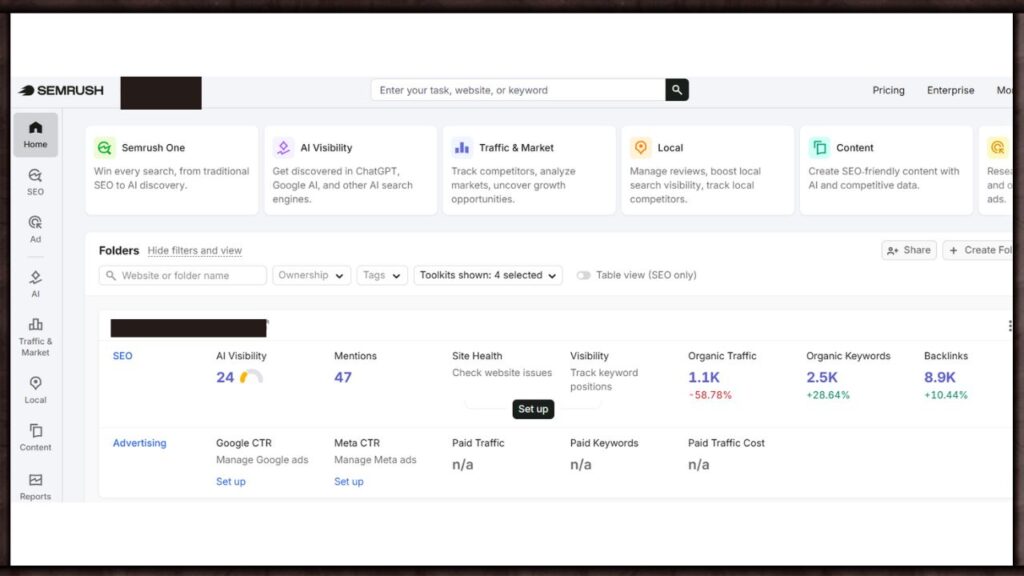
Keyword research that goes deeper than any competitor.
The Keyword Magic Tool gives you access to a database of over 25 billion keywords. Type in a broad topic, and it generates thousands of related keywords with search volume, keyword difficulty, and search intent clearly labeled.
One G2 reviewer who has been using the platform for over eight years specifically noted this as the tool’s consistent standout. For a small business trying to figure out what to write to actually bring in traffic, this is genuinely useful.
Competitor analysis that shows you exactly what’s working for others.
Type a competitor’s domain into the Domain Overview tool and SEMrush shows their top-ranking pages, the exact keywords bringing them traffic, and where their backlinks are coming from. You are not guessing anymore. You are looking at the data directly and building your content strategy around it.
Site audits that tell you what to fix and how to fix it.
The site audit tool crawls your website and surfaces issues like broken links, missing meta descriptions, slow pages, duplicate content, and more.
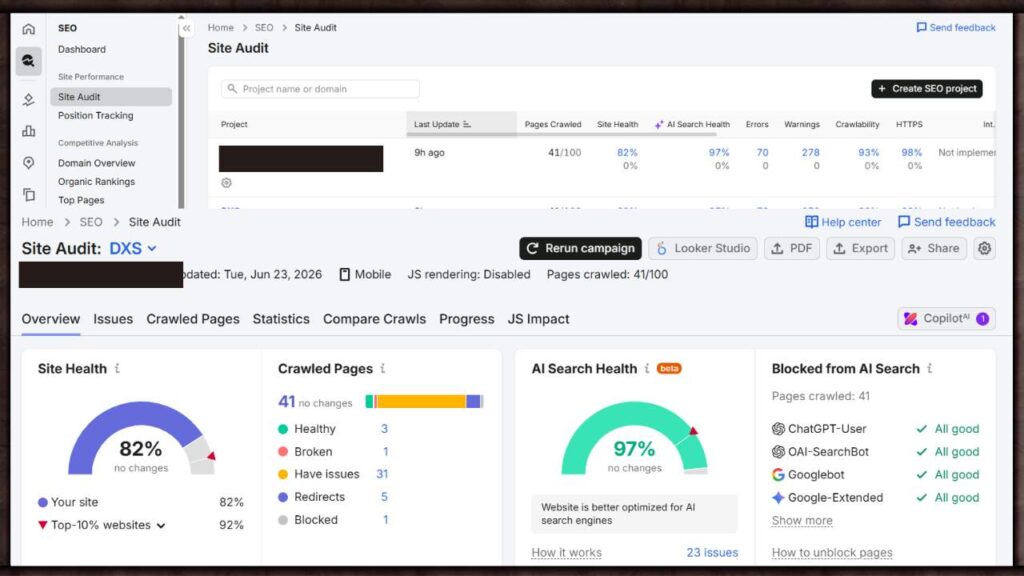
Multiple reviewers on Capterra specifically highlighted that it doesn’t just flag problems, it tells you how to fix them step by step. For a small business owner with no technical SEO background, that is something.
AI visibility tracking — the genuinely new feature in 2026.
Semrush One now tracks how your brand appears inside AI-generated answers on ChatGPT, Gemini, and Google AI Overviews. As more searches result in AI answers rather than a list of links, knowing whether your brand is being mentioned or ignored inside those answers is increasingly important. This is something none of the traditional competitors currently match at this scale.
A free Chrome extension for quick research.
The SEMrush browser extension lets you see domain authority, traffic data, and keyword metrics directly in your browser without opening the platform. Useful for quick competitor checks without logging in. Of course, you need a paid version for more useful details.
Where SEMrush Falls Short
Pricing is the single most consistent complaint across every review platform, and it’s worth being direct about it. One G2 reviewer called it “incredibly nickel and dimey.” A Reddit user posted: “This is getting out of hand. $199/month for a starter plan is wild. At that price point you’re paying almost $2,400 a year just for basic SEO data.” The base plan only includes one user seat and a team of three on the Guru plan ends up paying around $330 to $410 per month once you factor in the extra seat costs.
The billing practices are a separate issue entirely. One Capterra reviewer described being charged for an AdClarity add-on they did not clearly intend to subscribe to, with the charges continuing until they noticed, and the refund request denied.
This is not an isolated complaint, like Trustpilot’s AI-generated review summary explicitly identifies subscription, payment, cancellation, and refund as the five most-discussed negative topics. Removing your payment card also requires contacting support rather than doing it yourself, which is an unusual friction point.
There is also no browser extension for quick research in the traditional sense, which Ahrefs and other competitors offer more smoothly. And the learning curve is real, also the platform is large, and getting productive across all its tools takes time.
Is SEMrush Accurate? Can You Trust the Data?
This is one of the most searched questions about SEMrush, and the honest answer is: mostly yes, with caveats. The platform delivers reliable data that closely matches Google Search Console results and excels in keyword research accuracy compared to most competitors.
Its backlink database updates continuously and is one of the largest in the industry. Where SEMrush data can mislead is in traffic estimates for smaller or newer websites, the algorithm has less data to work with, so estimates can be less precise. For established websites in competitive niches, the data is generally reliable enough to make real decisions from.
How SEMrush Helps You Build Backlinks
Backlinks remain one of the top three ranking signals in Google’s algorithm in 2026, and SEMrush handles the full backlink workflow inside a single platform. Most tools make you jump between separate apps for research, outreach, and monitoring. SEMrush keeps all of it together.
There are four dedicated tools inside the platform covering every stage:
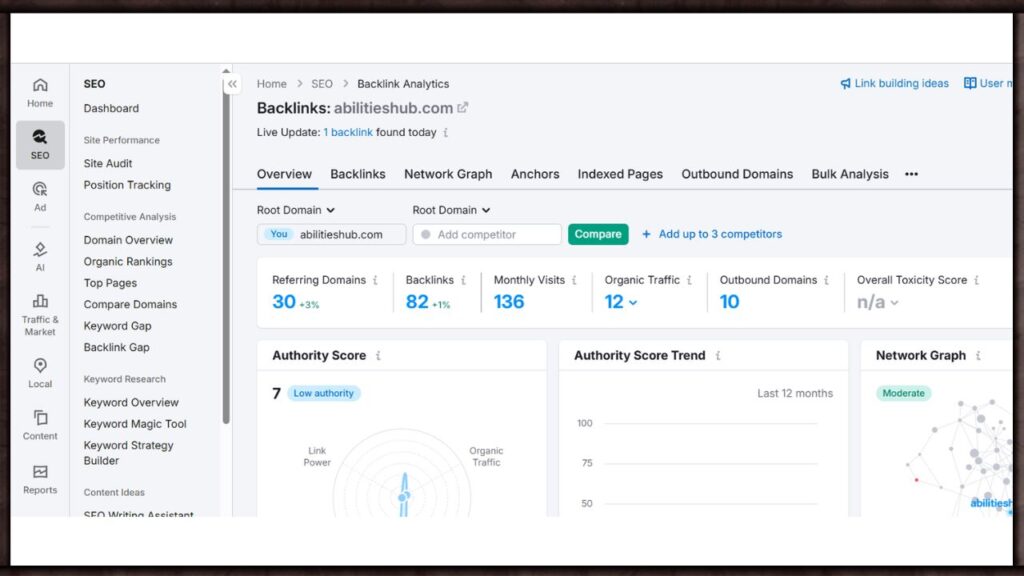
Backlink Analytics
It shows your full backlink profile like referring domains, anchor texts, authority scores, and which links are active, lost, or broken. You can run the same analysis on any competitor’s domain to see exactly where their links are coming from.
Backlink Gap
It is where the real value sits for a small business. Enter your domain plus up to four competitors, and SEMrush surfaces every website that links to them but not to you. In a 15-minute session, users consistently find 20 to 30 high-potential link building prospects they did not know existed.
Backlink Audit
It crawls your existing link profile and flags toxic or low-quality links that could be hurting your rankings. Worth knowing: Google’s own guidance as of 2026 is cautious about aggressive disavow use — only act on links that are clearly harmful, not everything the tool flags. Use the audit as a starting point, not a final verdict.
Link Building Tool
It brings outreach inside the platform. You enter your target keywords, SEMrush suggests relevant link prospects, and you can contact them and track your campaign progress without leaving the dashboard. The outreach module is functional, though for high-volume campaigns with dozens of simultaneous targets, a dedicated outreach tool like BuzzStream or Pitchbox will handle the complexity better.
One honest limitation worth knowing: SEMrush’s backlink database has 43 trillion links indexed, which is impressive, but Ahrefs updates its index faster. For day-to-day small business link building, this difference will not matter much. For agencies running time-sensitive outreach campaigns where freshness of data is critical, Ahrefs has the edge.
SEMrush Pricing — What It Actually Costs in 2026
This is where most buyers get caught off guard. The advertised plan price is almost never what you actually pay once you factor in extra user seats and add-ons.
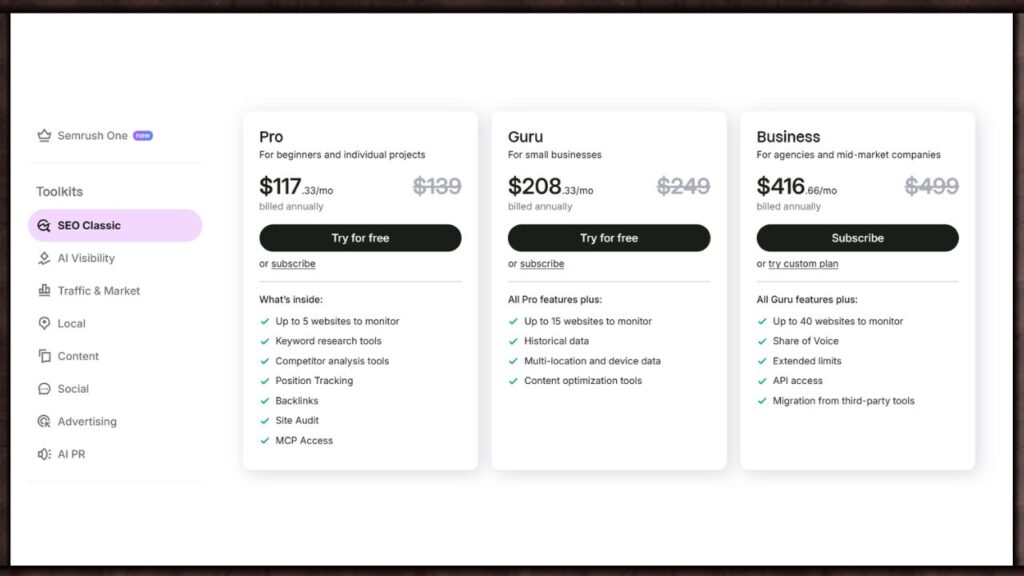
| Plan | Monthly Price | Annual Price (per month) | Projects | Keywords Tracked | User Seats |
| Pro | $139.95/month | $117.33/month | 5 | 500 | 1 |
| Guru | $249.95/month | $208.33/month | 15 | 1500 | 3 |
| Business | $499.95/month | $416.66/month | 40 | 5000 | 5 |
| Semrush One Starter | $199/month | Available | Combined SEO + AI Visibility | Bundled | 1 |
Annual billing saves approximately 17% across all plans. A 7-day free trial is available on paid plans, with a 14-day trial available through select partners.
The hidden costs nobody mentions upfront
Extra user seats cost $45 to $100 per month each. A 3-person team on Guru pays around $330 to $410 per month before any add-ons. Popular add-ons include the AI Visibility Toolkit at $99/month, the Trends add-on at $289/month, Local SEO at $30 to $60 per location per month, and the Social Media Toolkit at $20/month. A fully loaded Guru account for a team of three can easily exceed $600 per month. Know this before you commit.
SEMrush vs Ahrefs vs Moz — Which One Should You Use?
| Tool | Entry Price | Best For | Strongest At | Weakest At |
| SEMrush | $139.95/month | Full marketing suite: SEO, PPC, content, AI visibility | Keyword research depth, competitor intelligence, AI visibility tracking | Price, billing friction, no true browser extension |
| Ahrefs | $129/month Lite | Backlink research and competitive analysis | Backlink database refresh speed (15-30 minutes), clean UI | Content optimization, no free trial currently |
| Moz Pro | $99/month | Beginners and small businesses new to SEO | Ease of use, Domain Authority metric widely recognized | Keyword database smaller than SEMrush or Ahrefs, fewer tools overall |
- The honest comparison: SEMrush wins on breadth.
- Ahrefs wins on backlink data quality and interface cleanliness.
- Moz wins on accessibility for complete beginners.
For a small business that needs everything in one place and will actually use all the tools, SEMrush justifies the price. For a small business that mainly needs keyword research and site audits, Moz or SE Ranking cover most of the same ground for significantly less.
Who SEMrush Is Actually For
If you are running a content-driven small business where SEO is a core part of your growth strategy, publishing regularly, tracking competitors, and building backlinks, SEMrush is the right tool once your budget supports it. It’s also the right pick if you need PPC research alongside SEO, or if AI visibility tracking matters to you as AI-generated search answers become more common.
The Guru plan is where most serious small business users land, it’s where the content tools unlock and the platform starts to feel complete rather than limited.
Who Should Skip It
If you’re a solo blogger or small business just starting with SEO, the price is hard to justify against SE Ranking at around $65/month or Mangools at $29.90/month, both of which cover the core SEO functions at a fraction of the cost.
If you only need keyword research and rank tracking without competitor intelligence or content tools, you are paying for an entire marketing platform you’ll use 20% of. Wait until your SEO needs genuinely outgrow the cheaper tools before moving to SEMrush.
What I Like About SEMrush
The keyword research tool is genuinely the best in the category. The depth of data — 25 billion plus keywords with search volume, difficulty, and intent is hard to match elsewhere. The competitor analysis is also a real advantage: being able to see exactly what’s ranking for a competitor and why removes a lot of the guesswork from content planning.
And the move into AI visibility tracking with Semrush One is the right direction at the right time as AI search grows, knowing where your brand shows up (or doesn’t) inside ChatGPT and Gemini answers is genuinely useful information.
What I Don’t Like About SEMrush
The billing friction is real and well-documented. Being charged for add-ons you did not clearly subscribe to, and having to contact support to remove your payment card, are practices that create legitimate trust issues for smaller users.
Furthermore, in basic plans important perks like AI indexing etc are often missing. You need to upgrade in order to access them. I believe they users are missing on important SEO, GEO tools even after paying a premium which is a big drawback for me.
Finally, the per-seat pricing model also makes the real cost for any team significantly higher than the advertised number and that gap is rarely clear when you’re signing up. For a small business making decisions on tight margins, that kind of pricing opacity is a real problem.
The One Thing That Surprised Us
SEMrush is now an Adobe company as of April 28, 2026. The $1.9 billion acquisition closed ahead of schedule, and Adobe has explicitly signaled plans to integrate SEMrush data into its wider marketing cloud.
For small businesses, the short-term impact is minimal. But the longer-term direction is clear, SEMrush is being positioned as part of an enterprise marketing stack, not a small business tool. The pricing already reflects an enterprise-first pivot. Expect that trend to continue.
Final Take
SEMrush is the most complete SEO and digital marketing platform you can buy in 2026, and the data quality backs that up. For a small business that’s serious about content, search rankings, and competitive intelligence, it’s worth the investment at the Guru level.
But go in with clear eyes about the real monthly cost once seats and add-ons are factored in, and set a reminder to review your add-ons monthly, the billing complaints on Trustpilot are too consistent to ignore.
Start with the 7-day free trial, audit your own site, run competitor analysis on your two or three closest competitors, and see if the data you get in that window identifies enough actionable opportunities to justify the ongoing spend.
SEMrush is one of three tools we recommend for AI SEO and content marketing. See the full breakdown in our [Best AI Tools for Small Business to Boost Productivity in 2026] guide.
Read detailed and latest Surfer SEO Review HERE!
Read detailed and latest Jasper AI Review HERE!
Frequently Asked Questions
Is SEMrush worth it for a small business in 2026?
Yes, if you’re publishing content regularly and need keyword research, competitor analysis, and site audits together in one place. If you only need one or two of those features, cheaper alternatives cover them for less.
How accurate is SEMrush data?
Generally reliable for established websites in competitive niches, closely matching Google Search Console results in most cases. Traffic estimates for smaller or newer sites can be less precise since the algorithm has less data to work with.
Is SEMrush reliable as an SEO tool?
As a product, yes — it consistently rates 4.5/5 on G2 and 4.6/5 on Capterra from thousands of verified reviews. The reliability concerns are around billing and subscription management, not the SEO data itself.
What is SEMrush pricing in 2026?
The Pro plan starts at $139.95/month or $117.33/month billed annually. Guru is $249.95/month or $208.33/month annually. Business is $499.95/month or $416.66/month annually. Factor in extra user seat costs before committing.
Does SEMrush have a free trial?
Yes, a 7-day free trial is available on all paid plans. Some partner sites offer a 14-day extended trial on Pro and Guru plans.
Is SEMrush better than Ahrefs?
For overall breadth including PPC, content tools, and AI visibility tracking, SEMrush wins. For backlink research and interface cleanliness, Ahrefs is the stronger pick. Most serious SEO teams evaluate both before choosing.
Does SEMrush have a Chrome extension?
Yes, the SEMrush browser extension shows domain metrics, traffic estimates, and keyword data directly inside Google search results without opening the platform.
What is Semrush One and is it worth it?
Semrush One bundles traditional SEO tools with AI visibility tracking across ChatGPT, Gemini, and Google AI Overviews. Starting at $199/month, it’s worth considering if AI search visibility matters to your business strategy in 2026.
Why does SEMrush have a low Trustpilot rating?
The 1.9/5 on Trustpilot is driven almost entirely by billing and cancellation complaints, not product quality issues. The five most discussed negative topics on Trustpilot are subscription, payment, cancellation, customer service, and refunds — not SEO data or features.
What are the best SEMrush alternatives for small businesses?
SE Ranking at around $65/month covers core SEO at roughly one-third the cost. Mangools at $29.90/month is the most affordable entry point. Ahrefs Lite at $129/month is the cleanest alternative for backlink-focused work. Surfer SEO at $99/month is better than SEMrush specifically for content optimization.

3 Responses