

Typical AI tools for small business in 2026 often provide almost the same type of value. There is a big ‘BUT’ here. If you want AI tools to perform fast, accurately, and with precision, you need to go deeper. ChatGPT, Claude, and Grok etc. are more or less built for a wider audience. What you need is a specialist that can replace or improve a proper job role.
Only 8% of small businesses are reaching advanced AI adoption levels in 2026. The rest? Well, they are either stuck at GPT level, or are at experimental stages. If you want to be in the top 8%, read on!
This blog post is written and structured in a format that can help you improve your workflow and productivity as a small business owner. Let’s dig deeper!
The Real Cost of Running a Small Business Without AI
When everyone is using AI to boost productivity, you will only lose money and pay extra hours if you run your business without it. First, you are losing productivity, and second, you are paying extra on repetitive tasks. In short, you are losing on both ends.
Poor customer experience, late deliveries, human errors, and employee burnout are only the tip of the non-AI iceberg. Furthermore, your competitors are scaling faster, building customer trust, and embracing the latest technology. Without AI, you are losing in both the long and short term.
Simply put, with AI integrations your small business scales faster, automates repetitive tasks, keeps clients happy, delivers faster turnarounds, and saves a huge amount of money.
How to Use This Guide
The categories below represent integral parts of almost all businesses. First, see which categories are related to your business. Next, go through each one and read it carefully. You will find that all categories are structured in the same way.
In the first subheading you will learn what you are missing out on and how a non-AI approach is harming your small business. Next, you will learn how AI can change that. After that, you will find the most common issues you might be facing in that particular category. Finally, in the last part of each category, you will find tried and tested AI tool recommendations.
Category 1: Bookkeeping & Accounting
Bookkeeping and accounting are integrals part of any business in any part of the world. Whether you are a one-person operation or managing a small team, keeping your finances in order is not optional — it is the backbone of every business decision you make. Ignore it and you are flying blind. Get it wrong and it costs you more than just money.
What It’s Costing You Right Now
You might already be paying $1,500 to $2,000 to a part-time bookkeeper. And some of you have even hired an accounting firm with expenses ranging from $4,000 to $5,000 per month.
And if you have gone the in-house route, a full-time bookkeeper costs anywhere from $3,500 to $5,800 per month — and that is before you factor in benefits, payroll taxes, and software. Some of you have even hired a local CPA firm, which can run $400 to $800 per month just for basic compliance work.
What AI Does Instead
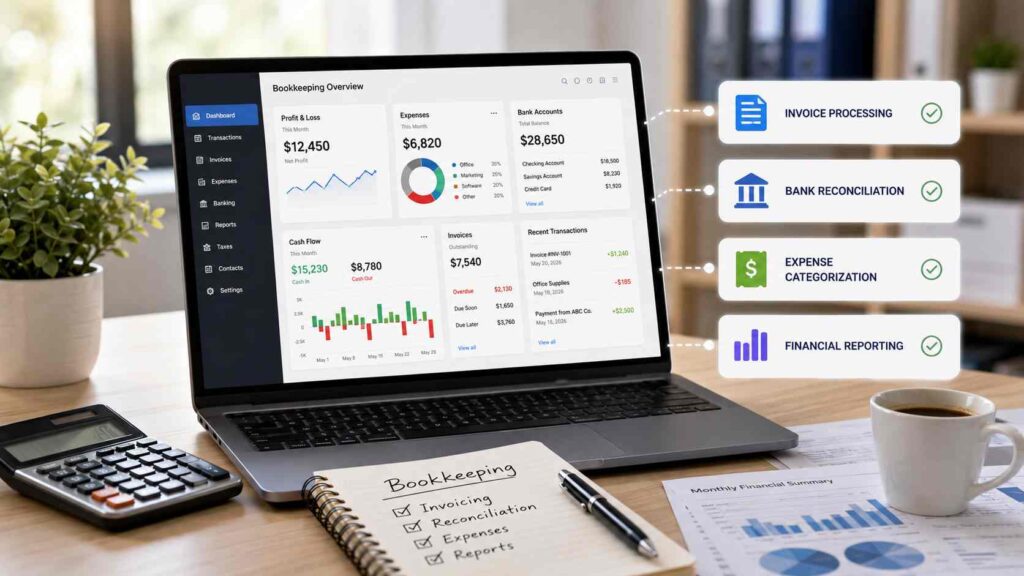
A specialist AI bookkeeping tool can handle invoice processing, bank reconciliation, expense categorization, and financial reporting — at only $29 to $130 per month. The speed is not even comparable. What a human bookkeeper spends hours on, AI completes in minutes. And it runs 24/7 without sick days or payroll overhead.
Common Problems Small Business Owners Face With Bookkeeping
- Chasing receipts and invoices at the end of every month
- Reconciliation errors that take hours to trace back
- No real-time view of where the money is going
- The cost of a bookkeeper eating into tight margins
- Tax season becoming a nightmare because records are not up to date
What Type of Tool Suits You Best
If you are a solo operator or freelancer, Bookeeping.ai is your starting point — it is simple, affordable, and handles the basics well.
If you run a small team with slightly more complex finances, Dext is a strong fit for capturing receipts and syncing with your existing accounting software.
If you work with an external accountant or accounting firm and want AI to sit on top of that relationship, Botkeeper is built for exactly that.
Top AI Bookkeeping Tools in 2026
Some of the highly accurate AI bookkeeping and accounting tools are:
- Bookeeping.ai — Automates up to 95% of bookkeeping tasks including invoicing, transaction categorization, and financial reporting. Starts at $29/month. [Read full Bookeeping.ai review →]
- QuickBooks Online — Combines AI automation with human accountant oversight. Best for businesses that want AI speed without giving up professional review. Starts at $299/month. [Read full Botkeeper review →]
- Dext (formerly Receipt Bank) — Captures receipts, invoices, and bank statements with 99.9% extraction accuracy and connects directly to QuickBooks, Xero, and Sage. [Read full Dext review →]
Category 2: SEO & Content Marketing
To boost your online presence and reach a wider audience and potential clients, you hire SEO experts and content marketing teams. In 2026, if your business is not showing up on Google, it practically does not exist for a huge chunk of your potential customers. Your competitors are not waiting around, and neither is the algorithm.
What It’s Costing You Right Now
Again, they can cost you up to $5,000 per month. And still, there is no guarantee of output any time soon. The average small business pays $2,500 to $5,000 per month for a comprehensive SEO retainer in 2026. And that is just for one agency working on one website.
Add a content writer or two on top, and you are looking at a bill that most small businesses simply cannot sustain for long. The worst part? SEO requires at least six months of consistent investment before you see meaningful results — so you are paying thousands every month before a single sale comes through.
What AI Does Instead
Now, with AI tools for SEO and marketing, not only can you save 90% of the money, but you can also stay updated with the progress in real time. Yes, you may have to do a few minutes of work, but that is all.
The tool does the heavy lifting. You can track progress in real time, adjust on the fly, and actually see what is working instead of waiting for a monthly agency report.
Common Problems Small Business Owners Face With SEO & Content
- Paying an agency for months with no visible results
- Not knowing which keywords are actually driving traffic
- Producing content that ranks for nothing because it was not researched properly
- No time to write consistently
- Competitors outranking you because they are producing more content, faster
What Type of Tool Suits You Best
If you are just getting started and need help writing and optimizing content at the same time, Surfer SEO is the right starting point — it guides you through exactly what to write and how to structure it.
If your priority is producing large volumes of on-brand marketing content fast, Jasper is built for that.
And if you want a full SEO suite that covers keyword research, rank tracking, backlink analysis, and competitor research all in one place, SEMrush is the most complete option on the market.
Top AI SEO & Content Tools in 2026
Some of the finest AI tools for SEO & Content Marketing in 2026 are:
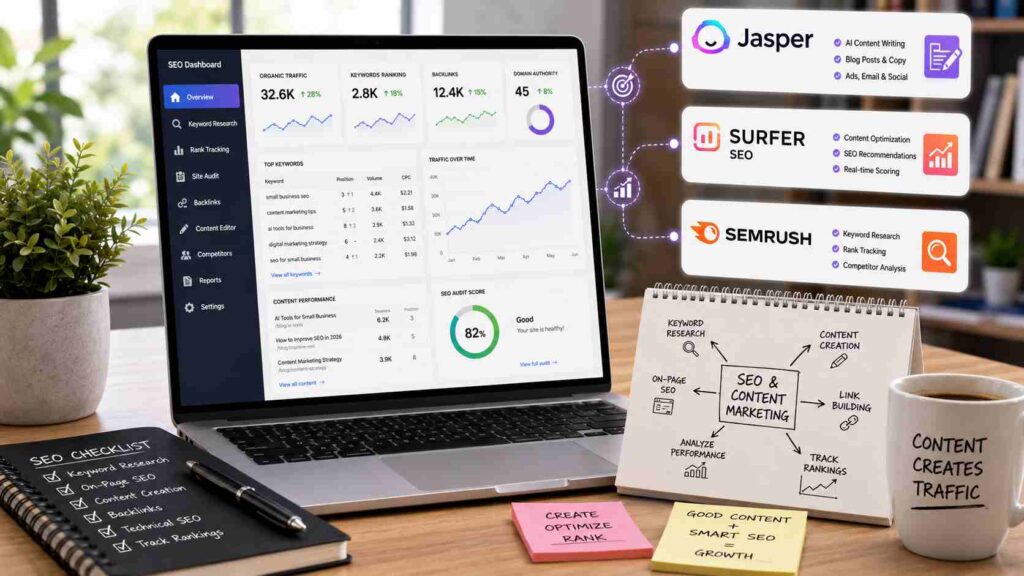
- Jasper — An AI writing tool built specifically for marketing content. It learns your brand voice and generates blog posts, ad copy, email campaigns, and social media content. Creator plan starts at $39/month billed annually, Pro plan at $59/month billed annually. 7-day free trial available. [Read full Jasper review →]
- Surfer SEO — Analyzes top-ranking pages for your target keyword and tells you exactly how to structure and write your content to compete. Starts at $89/month. [Read full Surfer SEO review →]
- SEMrush — The most complete SEO platform available for small businesses. Covers keyword research, site audits, rank tracking, backlink analysis, and competitor research. Pro plan starts at $139.95/month. [Read full SEMrush review →]
Category 3: Customer Support
A friendly and clever customer support team is the backbone of your business, and your clients’ trust and satisfaction. In this category, you might already be paying thousands of dollars per month to a third-party service or an in-house team.
In previous years, AI was not up to the point of communicating like a human CS agent. But now things have changed, and the following AI tools for customer support totally change the game. Using any one of these can save you thousands of dollars. The best part is that they are online 24/7.
What It’s Costing You Right Now
Small and mid-sized businesses spend $5,000 to $15,000 per month on outsourced customer support. If you have an in-house team, factor in salaries, training, shift coverage, and software — and the number climbs even higher.
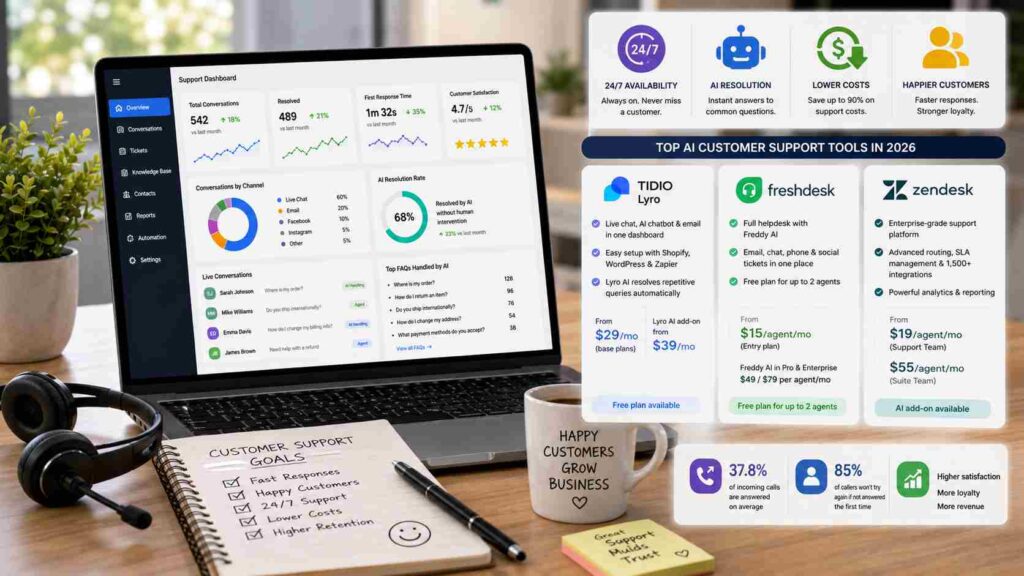
On top of that, businesses only answer 37.8% of incoming calls on average, meaning roughly two-thirds of potential customers never reach a person. And 85% of callers will not try again if you do not pick up the first time. That is not a support problem — that is a revenue problem.
What AI Does Instead
AI customer support tools handle incoming queries around the clock, pull answers from your FAQs and product pages, and resolve common questions without any human involvement. When something is too complex, they hand it off to a real person.
For a small business handling 100 to 600 support conversations per month, realistic AI support costs land between $80 and $1,500 per month — a fraction of what a human team costs. And unlike a human team, AI does not clock out at 5 PM.
Common Problems Small Business Owners Face With Customer Support
- Slow response times that frustrate customers and damage trust
- Paying for a full support team when most of the queries are the same five questions
- No coverage outside business hours, especially for international customers
- Inconsistent answers depending on which agent picks up
- Support costs that scale with volume, making growth expensive
What Type of Tool Suits You Best
If you run an e-commerce or product-based small business and need a quick, affordable setup with live chat and AI in one place, Tidio is your starting point.
If your support volume is growing and you need proper ticket management, reporting, and AI without a massive price tag, Freshdesk is the right step up.
And if you are scaling fast, managing multiple support channels, and need an enterprise-grade helpdesk that grows with you, Zendesk is built for that.
Top AI Customer Support Tools in 2026
- Tidio’s Lyro — Combines live chat, AI chatbot, and email in one dashboard. Especially popular among small businesses and e-commerce stores thanks to easy setup and integrations with Shopify, WordPress, and Zapier. Lyro AI resolves repetitive queries automatically. Base plans start at $29/month, with Lyro AI available as an add-on from $39/month. Free plan available. [Read full Tidio Lyro review →]
- Zendesk — The most complete customer support platform on the market. Best for businesses that need depth — advanced routing, SLA management, 1,500+ integrations, and detailed analytics. Plans start at $19 per agent per month for the Support Team plan, with the Suite Team plan at $55 per agent per month. Advanced AI is available as a separate add-on. Not the cheapest option, but the most scalable. [Read full Zendesk review →]
- Freshdesk — A full helpdesk platform with AI built in through its Freddy AI engine. Handles email, chat, phone, and social tickets from one place. Entry-level paid plans start at $15 per agent per month, with Pro and Enterprise plans including Freddy AI at $49 and $79 per agent per month. Offers a free plan for up to 2 agents — one of the few tools in this space with a genuinely usable free tier. [Read full Freshdesk review →]
Category 4: Legal & Contracts
AI may not be able to present your case in the courtroom or handle legal talks yet, but it can certainly save you thousands in handling lawyer work for routine documentation.
For most small businesses, the majority of legal spend goes toward the same handful of tasks — reviewing vendor contracts, drafting NDAs, and staying on top of compliance. None of that requires a courtroom. All of it can be handled by AI.
What It’s Costing You Right Now
Companies are paying up to $2,000 per month for simple legal document preparation. And if you need ongoing support for contract reviews, employment agreements, and vendor terms, some lawyers charge monthly retainers ranging from $500 to $5,000 per month depending on the level of service. That is before you even factor in the time spent waiting for a lawyer to get back to you, chasing approvals, and going back and forth on revisions.
What AI Does Instead
These AI tools replace lawyers for routine documents, and they work with more accuracy — the chances of errors are almost zero. They review contracts, flag risky clauses, suggest better language, and generate standard documents in minutes rather than days. And unlike a lawyer on a retainer, they are available the moment you need them.
Common Problems Small Business Owners Face With Legal Work
- Paying lawyer rates for the same routine documents over and over
- Signing contracts without fully understanding what the clauses mean
- Missing risky terms because reviewing a 20-page contract takes time you do not have
- Waiting days for a lawyer to review something simple
- No system for tracking contract renewals, deadlines, or obligations
What Type of Tool Suits You Best
If you are a small business owner regularly reviewing vendor contracts, NDAs, and service agreements and want something straightforward with no learning curve, goHeather is your best starting point.
If you or your team draft contracts directly in Microsoft Word and want AI suggestions built into that existing workflow, Spellbook fits naturally.
Finally, if you need to handle the full contract lifecycle including drafting, reviewing, signing, and tracking all in one place without bouncing between tools, Juro is built for exactly that.
Top AI Legal Tools in 2026
Some of the finest examples are:
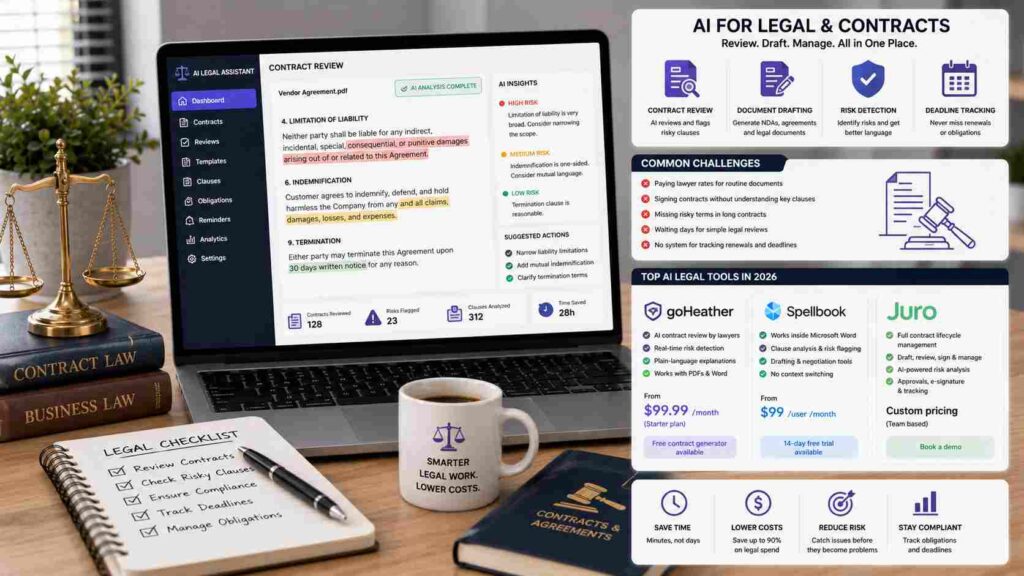
- goHeather — AI-powered contract review software built by lawyers that helps businesses review, redline, and understand contracts before legal gets involved. It provides real-time, plain-language legal analysis with jurisdiction-specific insights and works with both PDFs and Microsoft Word. Plans start at $99.99/month for the Starter plan, with a free contract generator also available. No credit card required to try. [Read full goHeather review →]
- Spellbook — Lives directly inside Microsoft Word as an add-in. It combines clause identification, risk flagging, drafting, and negotiation into a single workflow without any context-switching. Best for businesses that already draft and review contracts in Word and want AI built into that process rather than having to learn a separate platform. Starts at $99 per user per month with a 14-day free trial available. [Read full Spellbook review →]
- Juro — Combines AI contract review with a complete contract lifecycle management platform, enabling teams to draft, review, negotiate, and manage contracts in one place. AI review features help surface risks, suggest improvements, and ensure compliance, while built-in workflows cover approvals, e-signature, and post-signature management. Best for fast-growing small businesses handling a growing volume of contracts who need one system to manage all of it. Custom pricing based on team size. [Read full Juro review →]
Category 5: Hiring & HR
The human resources department brings in the ideal candidates for your company, and some of the tasks require thorough screening — especially when going through hundreds of job applications. With AI tools for Hiring & HR, every detailed task is automated, precise, and 100% accurate.
And for a small business without a dedicated HR team, that matters even more because every bad hire costs you time, money, and momentum you cannot afford to lose.
What It’s Costing You Right Now
For small businesses with 1 to 100 employees, hiring costs typically range from $3,200 to $4,000 per hire. And that is just the direct cost. Every day a position stays vacant costs an estimated $500 in lost output for a standard role.
With the median time to fill a position sitting at 44 days, that is over $22,000 in productivity lost before you have even made the hire. If you are also paying a recruiter or posting across multiple job boards, the number climbs higher still.
What AI Does Instead
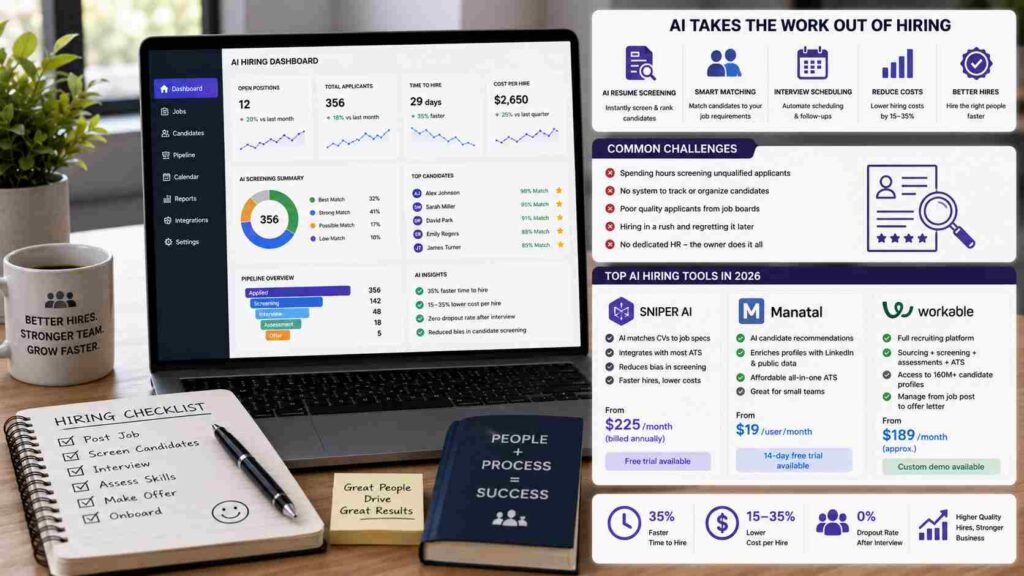
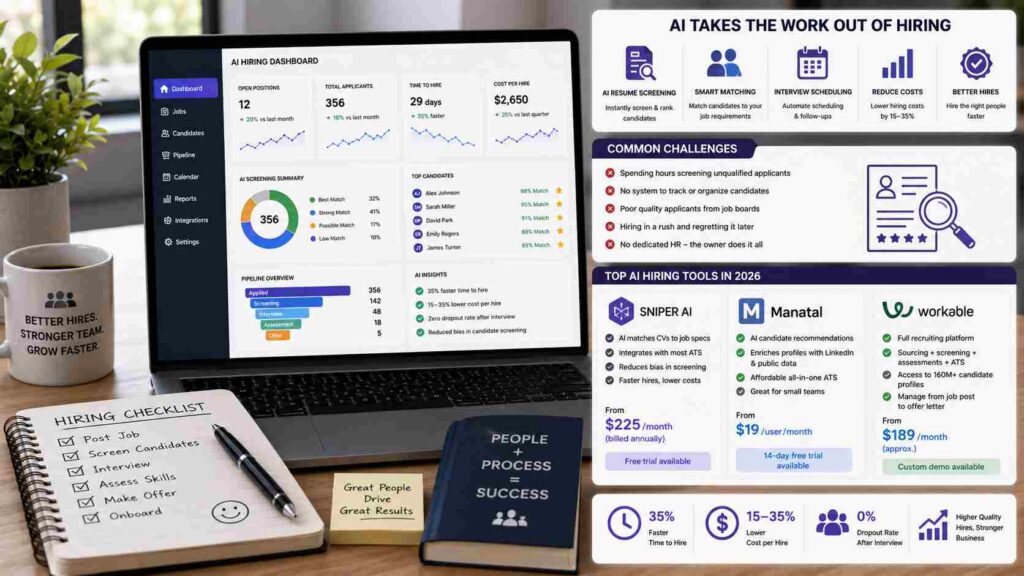
AI hiring tools screen resumes automatically, rank candidates against your job criteria, enrich profiles with additional data, and schedule interviews without any back and forth. What used to take a recruiter days of manual work gets done in minutes.
Sniper AI, for example, can speed up time to hire by 35% while keeping the dropout rate near zero and reducing the overall cost of hiring by 15 to 35%. You still make the final call. The AI just makes sure only the right people reach that stage.
Common Problems Small Business Owners Face With Hiring
- Spending hours manually reading through applications that clearly do not meet the requirements
- No system to track candidates, follow up, or keep the pipeline organized
- Posting on one job board and getting poor quality applicants
- Making a hire quickly out of desperation and paying for it later
- No dedicated HR person meaning the business owner handles everything themselves
What Type of Tool Suits You Best
If you already use an applicant tracking system and want AI to sit on top of it and do the matching and screening, Sniper AI plugs in without replacing your existing setup.
If you are starting from scratch and need an affordable all-in-one recruiting platform with AI built in from day one, Manatal is the most cost-effective option in the market right now.
Lastly, if your business is growing and you need sourcing, screening, assessments, and an ATS under one roof without having to piece together multiple tools, Workable handles all of it.
Top AI Hiring Tools in 2026
This way you save thousands of work hours every month. Some of the best HR-handling AI tools are:
- Sniper AI — Uses machine learning to match CVs and job specifications at speed and with high accuracy. Integrates with most applicant tracking systems and is suitable for corporate HR departments and recruitment companies. Its algorithm also hides identifiers like gender and nationality to reduce bias in the screening process. Pricing starts at $225/month on an annual contract with a free trial available. [Read full Sniper AI review →]
- Manatal — An AI-powered recruiting platform whose standout feature is candidate recommendations that go beyond simple keyword matching. It automatically enriches candidate profiles with data from LinkedIn and other public sources, giving you more context before the interview stage. Best for small to mid-size teams that want an affordable ATS with built-in AI candidate recommendations. Starts at $19 per user per month with a 14-day free trial available. [Read full Manatal review →]
- Workable — A full recruiting platform that covers sourcing, AI-assisted screening, candidate assessments, and applicant tracking in one place. Workable has access to a database of over 160 million candidate profiles, meaning you are not just screening who applied but actively finding people who fit your role. Best for small businesses that are hiring regularly and need one platform to manage the whole process from job post to offer letter. Paid plans start at approximately $189 per month. [Read full Workable review →]
Category 6: Workflow Automation
Every small business runs on a hidden engine — the daily back-and-forth between apps, tasks, and teams. Without the right system, this invisible layer of work quietly eats hours every week. Workflow automation AI tools connect all your moving parts together, eliminate manual handoffs, and keep everything running even when you are not in the room. Whether it is syncing data between platforms, automating follow-ups, or turning meeting notes into action items, these tools handle it so you do not have to. The result is a leaner, faster operation without hiring an extra pair of hands.
What It’s Costing You Right Now
More than half of employees spend at least two hours on repetitive tasks daily. For a small business with five people, that is ten hours a day — every day — going into work that generates zero new revenue.
A 10-person business where each employee spends just one hour per day on repeatable administrative tasks is losing between $18,000 and $30,000 per year in labor on work that could be automated. And that is before you count the missed follow-ups, delayed invoices, and dropped leads that come from doing everything manually.
What AI Does Instead
Workflow automation tools connect your existing apps, run multi-step processes automatically, and handle the repetitive back-and-forth that eats into your day. A new lead comes in — it gets added to your CRM, an email goes out, your team gets notified in Slack, and a follow-up task is created, all without anyone touching it.
Small businesses that adopt workflow automation save an average of 6 to 10 hours per week in administrative labor per employee, and the tools typically pay for themselves within 60 to 90 days.
Common Problems Small Business Owners Face With Workflow
- Jumping between 5 or 6 different apps just to complete one simple task
- Following up on leads or clients manually because nothing reminds you automatically
- Data living in different tools that never talk to each other
- Processes that only work when you are personally overseeing them
- Spending Sunday nights catching up on admin work that piled up during the week
What Type of Tool Suits You Best
If you want to connect your apps and automate tasks without writing a single line of code and need access to the widest possible range of integrations, Zapier is the easiest starting point.
If you need more complex multi-step workflows with branching logic and want a more affordable alternative to Zapier, Make.com gives you significantly more power at a lower price.
And if your team runs on documents, wikis, and internal knowledge and you want AI built directly into that workspace to summarize meetings, answer questions, and turn notes into action items, Notion AI is the right fit.
Top AI Workflow Automation Tools in 2026
- Zapier — Connects over 6,000 apps through simple trigger-and-action workflows called Zaps. No coding required. You set the trigger, you set the action, and Zapier handles the rest every time it fires. Free plan available, with paid plans starting at $19.99 per month for the Starter plan billed annually. Most small businesses land on the Professional plan at $49 per month once they need multi-step logic at volume. [Read full Zapier review →]
- Notion AI — Turns your Notion workspace into an active team member. It summarizes meeting notes, drafts documents, answers questions about anything stored in your workspace, and can run multi-step tasks autonomously. Notion AI is bundled into the Business plan at $15 per member per month billed annually, making it the cheapest entry point to the full AI feature set. Best for teams that already live in Notion or want one tool that handles internal documentation and AI workflow assistance together. [Read full Notion AI review →]
- Make.com — A visual workflow builder that handles more complex multi-step automations than Zapier at a lower price point. You build your workflows like a flowchart, connecting apps and adding logic, filters, and conditions without any coding. Starts at $10.59 per month for the Core plan, with a free tier available to test it first. Reviewers consistently describe it as more flexible than Zapier and better value for money once your automations get more complex. [Read full Make.com review →]
How Much Can a Small Business Actually Save With AI Tools?
AI tools in 2026 are the number one method to reduce spending. In fact, due to inflation they have become a necessity. A small business can save up to 70% of their usual costs around repetitive tasks which consume unnecessary man hours.
Nearly two-thirds of small businesses report saving between $500 and $2,000 per month after adopting AI, and most of that money goes straight back into growth rather than sitting idle. The average small business worker saves 5.6 hours per week using AI, while managers save over 7 hours. Put that across a five-person team and you are reclaiming a full working day every single week — without adding a single hire.
The savings are not limited to time either. When you add up what small businesses typically spend on bookkeeping, SEO, customer support, legal documents, and hiring combined, the monthly bill can easily cross $10,000 to $15,000.
The same results with specialist AI tools across those same categories cost a fraction of that. McKinsey’s 2026 data puts the average return on AI investment for small businesses at 3.7 times the cost. That means for every $100 you spend on AI tools, you are getting $370 back in saved labor, reduced errors, and recovered time. The businesses that are not doing this yet are not just missing out on savings, they are actively falling behind the ones that are.
How to Pick Where to Start
If you’re the owner of your small business or startup you know exactly where to start. Simply look at your routine tasks like marketing, bookkeeping, hiring, legal, and customer support etc. You will find that each type of job has a specialist Ai.
Don’t get me wrong, you’re not replacing your employees with Ai. Ai is not replacing humans, it is making your work fast, boost productivity, and intergrate automation where possible.
The final and critical decisions still need your input.
Finally, try getting specialist Ai tools which are built for specific jobs. For example Japser is ideal for writing tasks. Don’t go for generic Ai to perform everything. They may get the job done but the quality will suffer, and at the end you may lose more.
Frequently Asked Questions
Is AI accurate enough to handle my bookkeeping without an accountant?
AI handles the repetitive side well like transaction categorization, bank reconciliation, and invoice processing. But you still need a human to review the books before tax season, because AI does not know when it is wrong and tax law requires human judgment.
How much does it actually cost to run a full AI tool stack for a small business?
If you cover bookkeeping, SEO, customer support, legal, hiring, and workflow automation with specialist tools, expect to spend between $300 and $800 per month. That is still a fraction of what the same functions cost with human hires or agencies.
Will AI tools replace my employees?
For most small businesses, no. Only a third of small business owners think AI will make their business less reliant on employees. What it does is take the repetitive work off their plate so they can focus on work that actually requires a human.
Do I need any technical skills to use these tools?
No. Every tool in this list is built for non-technical users. If you can use Gmail and Google Docs, you can use any of these. Most offer onboarding walkthroughs and setup takes anywhere from 20 minutes to a couple of hours.
Can AI customer support really communicate like a human agent?
For common, repetitive queries Yes. For complex, emotional, or sensitive conversations, No, and it is not designed to. The best setup is AI handling the routine 70% and a human stepping in for the rest.
Is it safe to upload my contracts and financial documents to AI tools?
Reputable platforms use bank-level encryption and are SOC 2 compliant. Always check the security credentials of any tool before connecting your accounts or uploading sensitive documents. Avoid tools that are not transparent about their data practices.
Which category should a small business tackle with AI first?
Start where your biggest cost or time drain is. For most small businesses that is either bookkeeping or customer support both have the clearest ROI and the fastest setup time. Get one working well before adding the next.
Can AI SEO tools actually help a brand new website rank on Google?
They give you the right structure and content strategy from day one, which is more than most new sites have. Ranking still takes time. And AI does not skip the six-month curve but it makes sure every piece of content you publish has a real shot at ranking rather than guessing.
What happens if an AI legal tool makes an error in a contract?
The business owner is ultimately responsible. Saying “the AI did it” is not a valid defense with the IRS or in a court. Use AI legal tools for routine documents and flag anything complex for a qualified lawyer to review before you sign.
How many AI tools should a small business be running at one time?
The typical small business in 2026 runs a median of five AI tools. That is a reasonable benchmark, one per major function. The mistake most businesses make is adding tools without a clear purpose, paying for subscriptions that go unused within 90 days.

7 Responses